
'Retro-classic,' urban influences distinguish a new generation of ballparks, including ones in Pittsburgh, Minneapolis and San Diego
By Trevor Gomes
When Oriole Park at Camden Yards opened in 1992, it ushered in a new era of major league ballpark architecture. More than two-thirds of current major league ballparks have been created since then, and virtually every one has borrowed elements from Camden Yards by conforming to the “retro-classic” design.
“No ballpark has been built since Camden Yards … whose designers say Camden Yards doesn’t matter,” former New York Times architecture critic Paul Goldberger said in an interview with the Shirley Povich Center for Sports Journalism. “Everybody’s been influenced to some extent.”
Larry Lucchino, president of the Baltimore Orioles during the planning of Camden Yards, was adamant about creating an intimate ballpark that harked back to the venues of the early 20th century, Joe Spear, the principal design architect of Camden Yards, told the Povich Center. For Lucchino, a Pittsburgh native, Forbes Field, the Pirates’ home from 1909 to 1970, was a powerful influence.
“He wanted it to be like ballparks used to be,” Spear said. “That was his focus.”
Rather than erecting a cookie-cutter concrete behemoth in the suburbs, the Maryland Stadium Authority located Camden Yards in the heart of Baltimore. Like traditional ballparks, Camden Yards sits within the city street grid. Even on opening day in 1992, it felt like it belonged in the neighborhood and had been standing for decades.
Fans looking toward center field have a view of the downtown Baltimore skyline. Eutaw Street, behind right field and center field, resembles a bustling city sidewalk on game days. Spear called it “a place to see and be seen.”
Looming over Eutaw Street is the Baltimore & Ohio Warehouse. One of the longest buildings on the East Coast, and the venue’s signature feature, it defines perhaps the most important ballpark in baseball history. Camden Yards’ facade is made of brick, just as the warehouse and many Baltimore buildings are.
The field’s asymmetrical dimensions, the “Camden Green” seats and details as minute as the cast-iron designs that adorn the outside of every aisle seat echo ballparks from a bygone era.
In the late 1980s, Spear and architectural design firm HOK Sport, now known as Populous, created a traditional ballpark: Pilot Field, now called Sahlen Field, in Buffalo, New York. The success of that project instilled confidence in the Orioles and the Maryland Stadium Authority that HOK could design a ballpark inspired by the sport’s classic venues.
Pilot Field was one of the earliest instances of a ballpark drawing from historic stadiums, according to MiLB.com. Like many classic ballparks, Pilot Field was designed to conform to an urban street grid. The outfield was open to showcase downtown Buffalo, and the dimensions and wall heights in the outfield were quirky – all elements seen at Camden Yards.
Spear recognized that Camden Yards would have a profound impact when he received a call from the editor of Architectural Record, one of the foremost architecture magazines.
Architectural Record was planning to publish an issue dedicated to sports, Spear recalled, and the editor requested a personal tour of Camden Yards. “I thought, well, that’s pretty cool,” he said.
Camden Yards blends with the city. As intended in its design, the brick warehouse, a relic of turn-of-the-century Baltimore, gives the modern ballpark an antique feel.
The design entailed a tough balancing act between amenities and aesthetics.
“The challenge was, how do you integrate all of the things that are expected in a late-20th-century ballpark while giving it the feeling of an early-20th-century ballpark?” said Goldberger, author of “Ballpark: Baseball in the American City,” which examines the ever-changing architecture and location of ballparks.
HOK Sport led the design for Camden Yards and several major league ballparks built since. Like Camden Yards, many of the ballparks were designed to uniquely resonate with their cities.
“We believe every ballpark needs to be inspired by and become part of the city where it is located — that way the fans fall in love with the park,” Spear said in an email. “They would never really do that if it were a clone of somewhere else.”
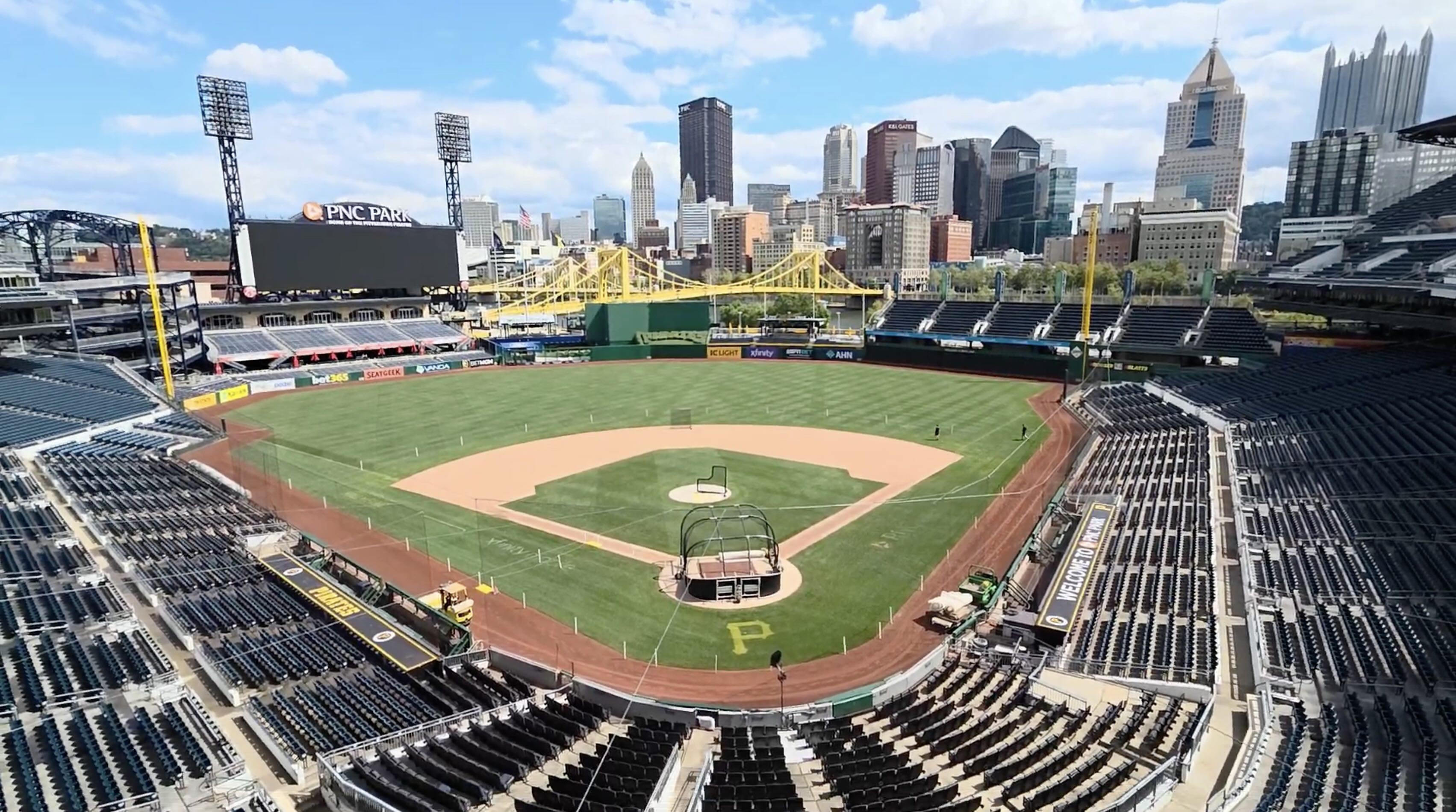
Pittsburgh
The Pittsburgh Pirates’ PNC Park, which opened in 2001, was designed with this philosophy in mind.
David Greusel, the lead designer and architect of PNC Park, characterized the construction of Camden Yards as a seminal moment for ballpark architecture.
“Stadium designers all over the country, especially at HOK Sport, but even at other firms, were starting to pay a lot more attention to things like urban design, context, history,” Greusel said. “It sort of opened the door to a more traditional kind of ballpark expression.”
Greusel considered urban design when designing PNC Park in the late 1990s. He was in favor of using stone, the same material used in Pittsburgh's civic buildings, rather than brick, which is heavily featured in Camden Yards, so the park would resemble a “Pittsburgh building.”
One of the foremost goals for PNC Park’s design, Greusel said, was to maximize the view of downtown Pittsburgh and the Roberto Clemente Bridge spanning the Allegheny River. The park’s center field was intentionally designed to be barren, without buildings or light standards, to allow an unobstructed view of the skyline.
Another commonality between Camden Yards and the succeeding ballparks was an emphasis on intimacy.
PNC Park’s suite level is nestled under the upper deck, which is cantilevered to conceal the luxury boxes. At first glance, the suite level seems nearly invisible, leaving the park with a cozier two-deck appearance. Greusel also believed that hiding the distracting suites would further immerse spectators in the ballpark’s atmosphere.
Minneapolis
Populous took a similar approach with Target Field, which opened in 2010 in Minneapolis. The firm conducted an analysis to identify the elements that characterize a Minnesota ballpark, Bruce Miller, the CEO of Populous and principal designer of Target Field, said.
“We were trying to capture kind of the spirit of that Upper Midwest with the natural limestone, using wood … natural materials, sustainable materials throughout the design of the ballpark,” Miller said.
Miller also characterized Target Field as “the most urban ballpark we’ve done” because of the tight confines. He and the designers joked that every survey seemed to reduce the ballpark’s dimensions by 10 feet.
The ballpark’s tight geometry lends itself to intimacy, though. The Minneapolis skyline flanks Target Field and the venue’s proximity to the city necessitates that seating is closer to the field, a staple among classic ballparks.
“I think [Target Field has] those characteristics of the traditional ballpark. The seating being close to the field, limited foul territory,” Miller said. “I think we’ve accomplished … really trying to emulate the traditional features of a historic park in a modern architectural language.”
Another parallel between Target Field and Camden Yards is the availability of open socialization areas.
Target Field’s concourse is entirely open, so spectators never feel detached from the game. The venue features half-circle tables and lounge, barstool and drink rail seating to accommodate fans during a game’s downtime.
“Baseball is a game of moments, right? For a lot of the time, you’re just passively watching, and then something happens, and … you’re there for that moment,” Miller said. “But in the meantime, it’s a great sport because it encourages socialization. Being there with friends and family, and people you enjoy.”
Camden Yards has similar spaces beyond the outfield.
The Picnic Perch, in the 200-level seating section along left field, allows Baltimore fans to enjoy drink rail seating and home plate-shaped tables. Tucked behind center field is the Bullpen Picnic Area — an outdoor dining area dotted with orange umbrellas and Camden Green tables.
San Diego
The San Diego Padres’ Petco Park, which opened in 2004, also has similarities to Camden Yards. Downtown San Diego serves as the ballpark’s backdrop, and its dimensions are asymmetrical, staples of the retro-classic design that Camden Yards brought about.
The “Park at the Park” — which Boris Dramov, the master plan architect of Petco Park, says is one of the venue’s signature features — is perhaps the best example of a social area in a ballpark.
Petco Park’s most striking similarity to Camden Yards, though, is the Western Metal Supply Co. building.
Charles Steinberg, executive vice president of the Padres during the creation of Petco Park, worked alongside Lucchino in Baltimore, San Diego and Boston. Steinberg credits Camden Yards with inspiring the Padres to preserve the Western Metal building.
“[The idea] really did start with Camden Yards, where we, of course, went to great lengths to keep that warehouse,” Steinberg said. “We thought it was kind of funny when we got to San Diego … we traveled 3,000 miles and there’s another warehouse.”
Despite the similarities, Dramov intended for the ballpark’s design to differ from that of Camden Yards.
“Camden Yards, although a great facility, and it did great things for the Baltimore area, it was more of an approach of taking a kind of industrial, previous-century look of the architecture,” Dramov said. “I think the concept here was, we should do something new and different. We shouldn’t be doing another historical-looking ballpark.”
To Steinberg, the differences between Camden Yards and Petco Park are what make them similar.
The idea of designing an identifiable ballpark that meshed with its city, brought about by Camden Yards, was its foremost influence on Petco Park, Steinberg said.
Ballpark design has no one-size-fits-all formula, and each venue should be idiosyncratic. Spear says that the wave of traditional, retro-classic ballparks sparked by Camden Yards has slightly waned in recent years. In its place is a greater emphasis on venues that “reflect their surroundings/neighborhoods and have a sensitive scale and detailing.”
Even 33 years after Camden Yards was built, its influence remains.
Nyla Cherry contributed to this article.